How to Document HPI Using OPQRST in AfyaWingu Patient Management (Step-by-Step Guide)
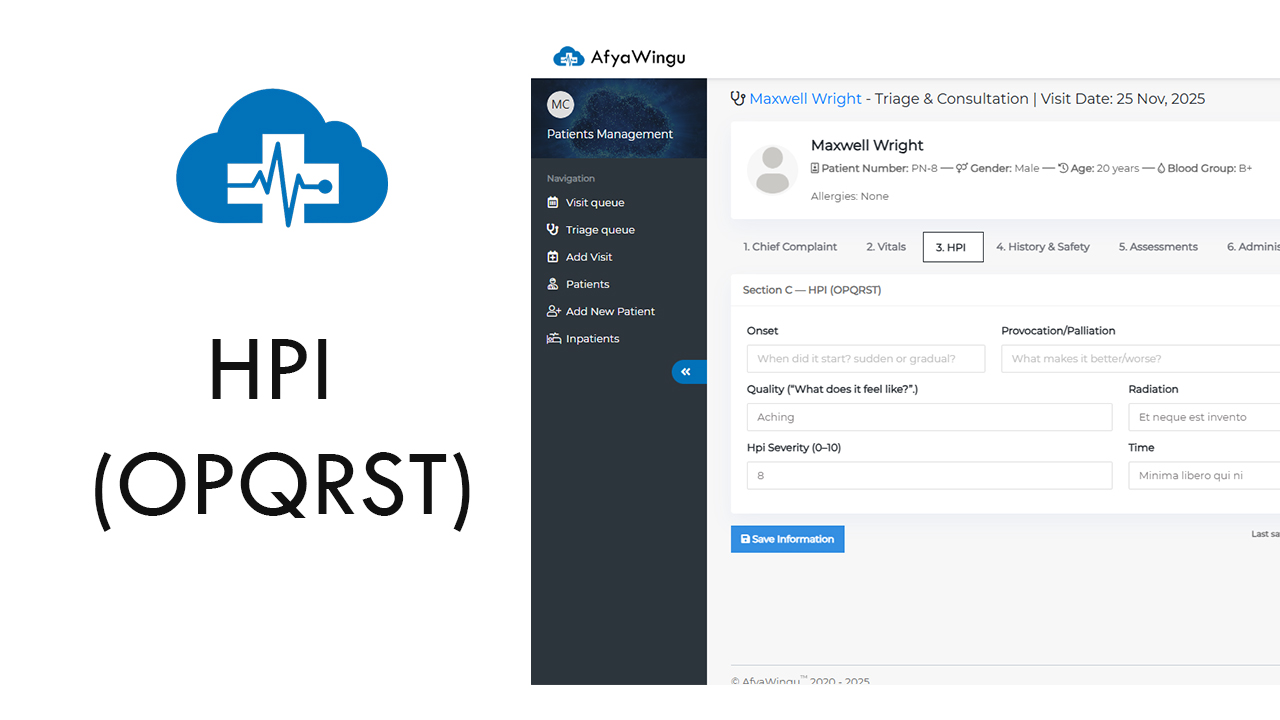
How to Complete the HPI Section in AfyaWingu Using the OPQRST Method
Welcome back to AfyaWingu Patient Management. This guide walks you through Section 3: HPI — History of Present Illness, where clinicians record a detailed narrative of a patient’s symptoms using the internationally recognized OPQRST method.
For this example, we continue with the patient record for Maxwell Wright, a 20-year-old male who visited the facility on November 25, 2025. With his Chief Complaint and Vital Signs already documented, it’s time to capture the deeper context behind his symptoms.
Understanding Section 3: HPI (OPQRST)
The HPI section helps clinicians document the complete story of the patient’s current illness. At the top of the AfyaWingu interface, Section 3 is highlighted in blue — making it easy to identify where you are in the workflow.
AfyaWingu uses the OPQRST mnemonic, a globally accepted tool for assessing symptoms:
- O – Onset
- P – Provocation/Palliation
- Q – Quality
- R – Radiation
- S – Severity
- T – Time
Below is a practical breakdown of each field and how best to document it.
1. Onset — When the Problem Started
Ask: “When did the symptom first start?”
💡 Examples you can enter:
28(meaning 28 hours ago)- “3 days ago”
- “Since yesterday morning”
- “Suddenly while walking”
Tip: Avoid vague terms like “a while ago.” Use specific times, numbers, or events.
2. Provocation / Palliation — What Makes It Worse or Better
Ask: “What affects the symptom?”
📝 Good examples:
- “Worse after eating spicy food, better when lying down”
- “Worse with deep breaths, relieved by rest”
Tip: Document anything that triggers or relieves symptoms — posture, medications, movement, food, stress, etc.
3. Quality — What Does the Symptom Feel Like?
Ask: “How would you describe the pain or sensation?”
📌 Example: Aching
Other common descriptors:
- Sharp
- Burning
- Stabbing
- Cramping
- Throbbing
- Tingling
- Numbness
Tip: Let the patient describe the feeling in their own words first.
4. Radiation — Does the Pain Spread?
Ask: “Does the pain move or spread to other parts of your body?”
📝 Real examples:
- “Spreads to my left shoulder”
- “Moves down my leg”
- “No radiation — stays in one spot”
Tip: If there’s no spread, write “None” or “Localized.”
5. Severity (0–10 Scale)
Ask:
“On a scale from 0–10, how bad is the pain right now?”
📌 Example: 8
Severity guide:
- 0–3: Mild
- 4–6: Moderate
- 7–10: Severe
Tip: Always ask again during HPI — pain may have changed since the initial triage.
6. Time — Duration, Pattern & Frequency
Ask:
“How long has this been happening? Is it constant or intermittent?”
📝 Good examples:
- “Constant for 2 days, getting worse”
- “Intermittent — every 2–3 hours, lasts 30 minutes”
- “Started suddenly last night, no improvement since”
Tip: Include patterns such as “only at night,” “after meals,” or “when standing.”
Additional Panels You’ll See in AfyaWingu
Quick Overview Panel (Right Sidebar)
This summary box displays:
- Allocated Doctor: Unknown
- Allocated Nurse: Unknown
- Visit Date: November 25, 2025
The “View Past Visit History” button below helps clinicians review previous episodes — especially useful for chronic or recurring illnesses.
Live Interpretation Panel
Based on the vitals you entered earlier, the system may show alerts such as:
- Fever
- Low SpO₂
These clues help guide your assessment and ensure nothing critical is missed.
Saving Your Work in AfyaWingu
Click the blue “Save Information” button at the bottom-left after completing the fields.
AfyaWingu auto-saves, but manually saving ensures all data is securely recorded.
You will also see:
Last saved: November 25th, 2025 | Updated By: Malaika Center
This supports accountability and smooth handover between clinicians.
What’s Next?
Once Section 3 (HPI) is complete, you can move to:
➡️ Section 4: History & Safety — Past medical history, medications, social history, allergies
➡️ Section 5: Assessments — Clinical impressions and differential diagnoses
➡️ Section 6: Administer Medications — Prescribing or giving treatment during triage
Each section helps build a complete, structured clinical picture — ensuring better patient outcomes.
Final Thoughts
Accurate HPI documentation is key to effective diagnosis and clinical decision-making.
AfyaWingu makes this process simple, structured, and intuitive — empowering clinicians to capture patient stories clearly and professionally.
If you'd like, I can also:
✅ Turn this into a downloadable PDF
✅ Create a shorter version for social media
✅ Format it for your AfyaWingu Help Center or Documentation
Just let me know!